Dysarthria in children: causes, signs, and correction
· 9 min read
When a child speaks with "mush in the mouth" and those around them struggle to understand their speech, parents often attribute it to laziness or age. But behind these symptoms, dysarthria may be hidden — a disorder that requires not just sessions with a speech therapist but a comprehensive approach involving a neurologist. In this article, I will explain how to distinguish dysarthria from simple "mispronunciation of sounds," what signs to look for, and how effective correction is structured.
What is dysarthria and how is it different from dyslalia
Dysarthria is a disorder of the pronunciation aspect of speech caused by insufficient innervation of the speech apparatus. In simple terms, the brain "sends a signal," but the muscles of the tongue, lips, palate, or larynx cannot execute the command due to damage to the nerve pathways. Unlike simple dyslalia, where the problem is only in incorrect sound pronunciation, dysarthria affects the entire complex: breathing, voice, tempo, and fluency of speech.
How dysarthria differs from dyslalia: a table
To make it easier for parents to understand the difference, I have compiled a visual comparison. It will help you get your bearings before visiting a specialist.
| Sign | Dyslalia | Dysarthria |
|---|---|---|
| Cause | Functional or mechanical | Organic CNS Damage |
| Articulation | Individual sounds are impaired | Entire speech is slurred |
| Muscle tone | Normal | Increased, decreased, or fluctuating |
| Drooling | Absent | Often pronounced |
| Voice | Clear, resonant | Quiet, weak, nasal |
| Coordination of movements | Not impaired | Gross and fine motor skills are affected |
Why it is important not to confuse these diagnoses
During appointments, I often see parents who have been taking their child to a speech therapist "for sounds" for years with no results. The fact is that for dyslalia, articulation exercises and sound production are sufficient. For dysarthria in children, sessions will be ineffective without correcting muscle tone and breathing. If your child has been in therapy for more than six months and their speech remains unclear, it is worth having them checked by a neurologist and a speech therapist-defectologist.
Causes of Dysarthria: Where the Problem Comes From
Dysarthria is always associated with damage to the central nervous system. Most often, this occurs in the perinatal period — during pregnancy or in the first months of life. It is important for parents to understand that this is not a "bad character" or pedagogical neglect, but a medical diagnosis requiring treatment.
Main causes in order
- Perinatal hypoxia: Lack of oxygen during pregnancy or childbirth is the most common cause. Oxygen deprivation damages the areas of the brain responsible for muscle movement.
- Birth injuries: Rapid or prolonged labor, umbilical cord entanglement, cesarean section (especially emergency) can lead to micro-hemorrhages in the brainstem.
- Cerebral palsy (CP): Dysarthria is a mandatory companion of cerebral palsy, but its severity can vary — from mild slurring to a complete absence of speech.
- Neuroinfections: Meningitis, encephalitis suffered at an early age often leave consequences in the form of impaired innervation.
- Toxicosis and maternal illnesses: Severe toxicosis, diabetes, hypertension during pregnancy disrupt fetal nutrition.
- Genetic syndromes: Less commonly, dysarthria can be part of a syndromic pathology (for example, in Down syndrome).
What parents need to know
Not all cases of dysarthria are linked to difficult childbirth. Sometimes the cause is hidden hypoxia that was not noticed immediately. Therefore, if a child has any of these factors in their history and speech development is delayed, I advise not waiting until 3-4 years old, but showing the child to a neurologist as early as one year.
Forms and degrees of dysarthria: from mild to anarthria
Dysarthria in children varies in severity. The mildest form is mild dysarthria, which is often confused with dyslalia. The most severe is anarthria, where speech is completely absent. Understanding the degree helps in choosing the correct correction strategy and realistically assessing the prognosis.
Dysarthria Severity Table
| Degree | Speech | Clarity for others |
|---|---|---|
| Mild | Slurred, unclear, "mushy" | Understandable to close ones, to strangers — with difficulty |
| Mild | Slow, monotonous, with a nasal tone | Clear in a calm environment, worsens with excitement |
| Moderate | Very unclear, weak voice, shallow breathing | Only understandable to parents, half of the words are lost |
| Severe | Speech is almost absent, only individual sounds or syllables | Not understandable to anyone, communication through gestures |
| Anarthria | Speech is completely absent | The child does not speak, only vocalizations are possible |
Features of Mild Dysarthria
Mild dysarthria is the most insidious form. The child speaks, sounds seem to be there, but speech is monotonous, slurred, "as if there is mush in the mouth." Often parents only notice that the child is lazy to pronounce complex words. In reality, such children have weak tone in the tip of the tongue; it simply cannot lift to the upper teeth. Mild dysarthria responds well to correction but requires more time than dyslalia — from 6 months to 1.5 years of regular sessions.
How to recognize dysarthria: signs by age
Many parents come to me with complaints about "unclear speech" only by age 4-5. But the first signs of dysarthria can be noticed much earlier. The sooner you see them, the faster correction can begin, and the better the result will be.
Early signals in infants under one year old
- Weak sucking: The child gets tired quickly, stops breastfeeding, milk leaks from the mouth.
- Choking: The baby often coughs during feeding, even if there is plenty of milk.
- Absence of cooing and babbling: By 6 months, no active babbling; by 9-10 months, no repeated syllables (ma-ma, ba-ba).
- Drooling: Excessive drooling after 6-7 months, when it should already be decreasing.
- Strange Cry: Weak, monotonous, with a nasal quality.
Signs of Dysarthria in Children After One Year
- Delay in first words: First words appear after 1.5 years, and phrases after 2.5-3 years.
- Slurred speech: The child speaks, but only the closest people understand them. Sounds are "swallowed," especially at the end of words.
- Difficulty chewing: Chews for a long time, dislikes solid food (meat, apples), chokes on crumbs.
- Tone disorder: You may notice the tongue is flaccid, lying in a "lump," or conversely, tense and "pointed."
- Nasal tone: The voice sounds "nasal," as if the child has a cold, but there is no runny nose.
- Monotony: The child speaks in a monotone, without intonation, and cannot change volume.
When to sound the alarm
If by age 3 a child speaks individual words but they are unclear, and those around them ask for a "translation," this is already a reason for a diagnostic assessment. Do not wait until age 5, thinking "they will start talking on their own." In dysarthria in children, without professional help, speech does not improve; instead, an incorrect pattern becomes established.
Diagnosis of Dysarthria: Who Makes the Diagnosis and How
The diagnosis of "dysarthria" is not made by a single specialist. It is a tandem effort: a neurologist confirms organic damage, and a speech-language pathologist assesses speech symptoms. Only then can a correction plan be discussed.
Stages of diagnosis
1. Neurologist examination: The doctor checks reflexes, muscle tone, and coordination. May prescribe an EEG, neck vessel ultrasound, or brain MRI — to understand which part of the CNS is damaged. 2. Speech therapy assessment: Our specialists evaluate the condition of the articulatory apparatus (mobility of the tongue, lips, soft palate), breathing, voice, and sound pronunciation. An important test is holding the tongue in a specific position — with dysarthria, the child tires quickly. 3. Functional tests: For example, asking the child to puff out their cheeks — with dysarthria, one cheek may "sag," or showing the tongue — it may deviate to one side.
Why early detection is critical
The younger the child, the more plastic their brain. If correction for dysarthria begins at 2-3 years old, the chance of normalizing speech or significantly improving it is 80-90%. If started at 6-7 years old, correction will take 2-3 years and does not always lead to full recovery. Therefore, at the first signs of dysarthria, I advise not to delay a visit to a neurologist.
Dysarthria correction and prognosis
Treatment of dysarthria is not just speech therapy sessions. It is a complex approach that includes medication support, physiotherapy, and regular work at home. The result depends on the degree of impairment, the age at which correction begins, and the regularity of sessions.
Main methods of correction
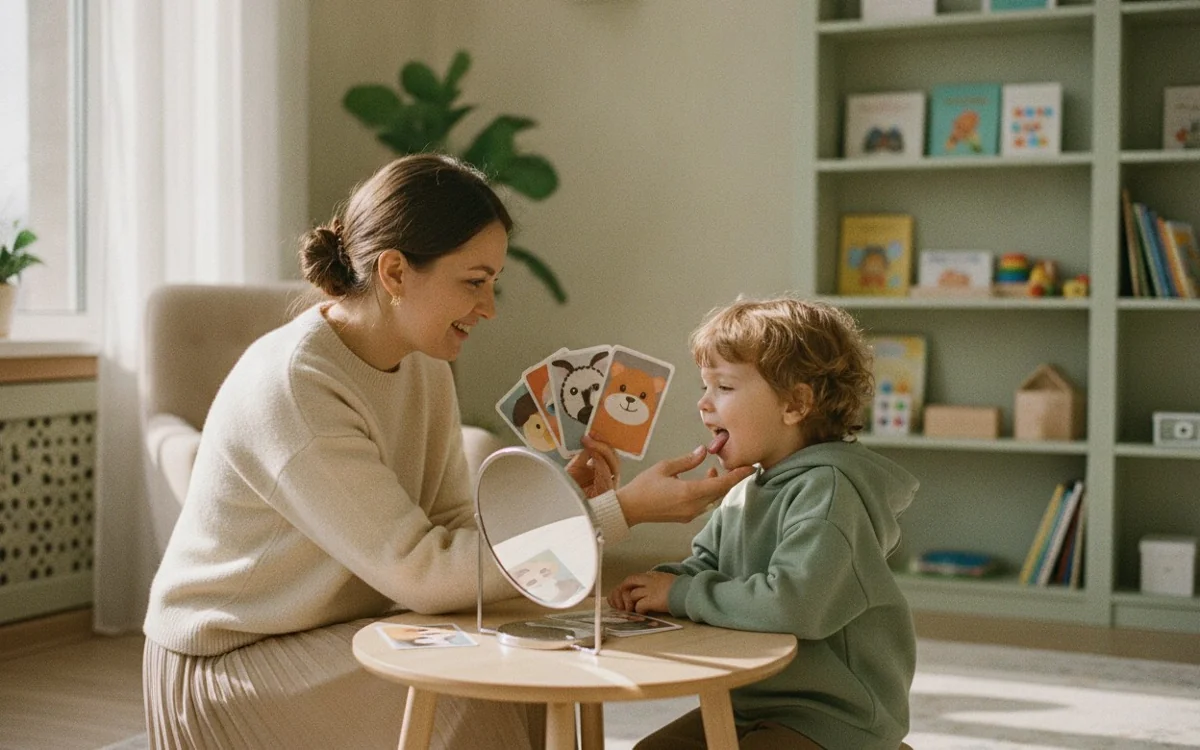
Speech therapy massage for dysarthria is one of the key tools. It helps normalize muscle tone: relax tense muscles or activate weak ones. I use probe and manual massage, as well as tongue massage with special attachments. A course is usually 10-15 sessions, repeated 2-3 times a year.
Articulation exercises are the foundation for sound production. However, with dysarthria, they differ from standard ones: exercises are done at a slow pace, with holding the position. For example, holding the tongue in a "cup" shape for 10-15 seconds is a serious effort for a child with dysarthria.
Breathing exercises are mandatory, as dysarthria often involves shallow, clavicular breathing. We teach the child to produce a long, smooth exhale (through a straw, blowing up balloons, blowing away a cotton ball).
Medication support — only as prescribed by a neurologist. This usually includes nootropics, vascular medications, and B vitamins. They do not directly treat dysarthria but improve brain nutrition and the conductivity of nerve impulses.
What determines the timeline and outcome
- Degree of dysarthria: The mild form is corrected in 6-12 months. Moderate — in 1.5-3 years. Severe — speech may remain slurred, but it can be made understandable to others.
- Regularity of sessions: 2-3 times a week with a speech therapist and daily home practice (15-20 minutes). Without home practice, there will be no result.
- Age of onset: The earlier, the better. After age 7, brain plasticity decreases, and correction proceeds more slowly.
Prognosis
With timely and comprehensive correction, most children with mild and minimal dysarthria achieve clear speech and successfully study in a regular school. For moderate and severe forms, the goal is not "perfect pronunciation" but functional speech that is understandable to others. Even with anarthria, modern methods (including alternative communication) allow the child to communicate.
If you notice signs of dysarthria in your child, don't panic, but don't wait either. Come for a diagnosis — our speech therapists will help you understand exactly what is happening with your child's speech and create a plan that will deliver real results.
