Speech therapy massage: when it is needed and how it goes

· 6 min read
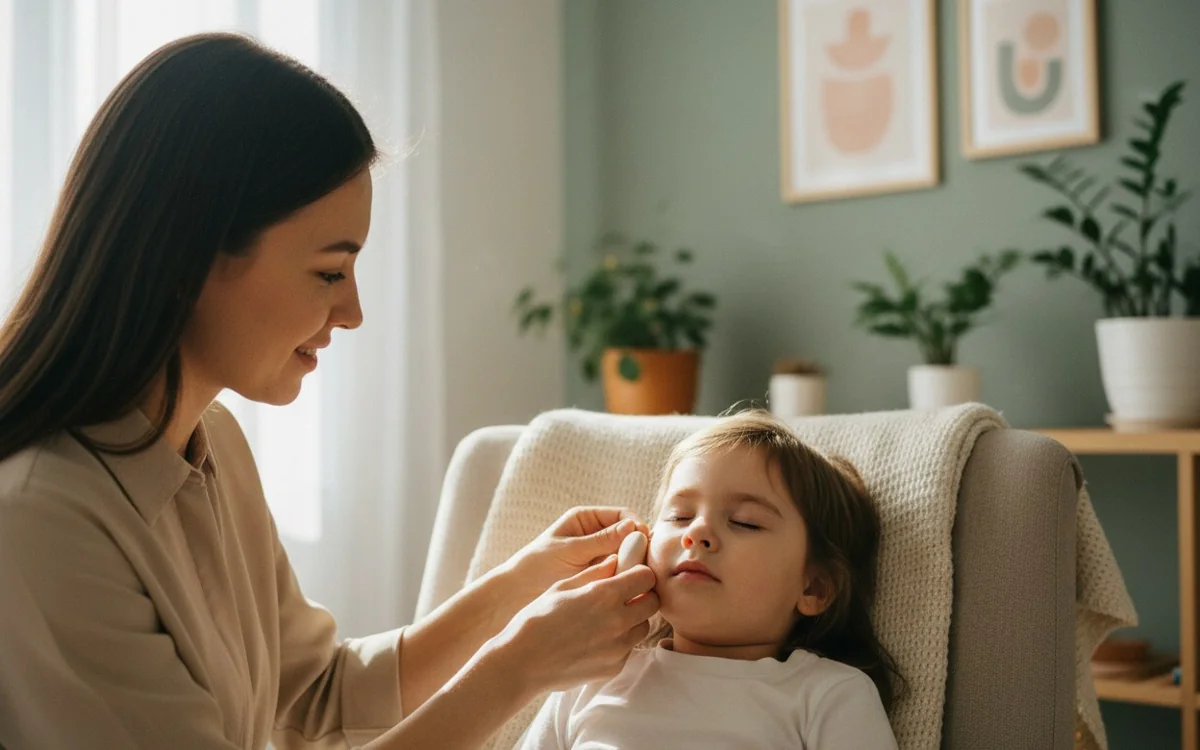
Many parents, upon hearing a speech therapist’s recommendation to undergo a course of speech therapy massage, imagine something frightening or doubt its necessity. In this article, I will explain what this procedure is, in which cases it truly helps, and how a session is conducted, so you can make an informed decision.
What is speech therapy massage and how does it work
Speech therapy massage is a method of mechanical stimulation of the articulatory muscles that helps normalize their tone and prepare the speech apparatus for sound production. It is not just stroking, but targeted work with the muscles of the tongue, lips, cheeks, soft palate, and face.
The essence of the method and its effect on muscles
The method is based on reflex stimulation of nerve endings in the muscles and skin. When a child has impaired tone in the articulatory muscles — either too tense (hypertonus) or, conversely, too flaccid (hypotonus) — the tongue cannot assume the correct position for producing sounds. Speech therapy massage helps relieve excessive tension or, conversely, activate weak muscles. For example, with hypertonus, massage relaxes the root of the tongue, which is often spasmed, while with hypotonus, it stimulates the tip of the tongue, making it more mobile. Work is done not only on the tongue but also on the orbicularis oris muscle and the cheek muscles, so the child can tightly close their lips and control the airflow.
How it differs from general massage
General massage relaxes the whole body or its large areas, improving circulation and relieving overall tension. Speech therapy massage is targeted and narrowly focused. The therapist works on specific areas of the articulatory apparatus with millimeter movements, using special instruments or just fingers. With general massage, we do not consider tongue position or lip tone—that is the speech therapist's task. Additionally, speech therapy massage for children often has a clear sequence: first, we relax or activate a specific muscle group, then immediately move to articulatory gymnastics, reinforcing the new tone.
Why massage alone does not improve speech
This is a key point to understand. Speech therapy massage is a supplementary, not primary, method. It creates a physiological foundation for speech: normalizes muscle tone, increases the range of tongue movement, and improves sensitivity. However, massage alone will not teach a child to pronounce the sound "r" or form a sentence. After a course of massage, speech therapy sessions are essential: sound production, phonemic awareness development, and work on vocabulary and grammar. If you only perform massage without active speech work, the results will be minimal. Massage prepares the "soil," while sessions "plant the seed" of correct speech.
Who is speech therapy massage indicated for
Speech therapy massage is not a procedure for all children with speech problems. It is prescribed strictly based on indications, most often for neurological disorders of the articulatory apparatus. Without a speech therapist's diagnosis, starting it is pointless.
Dysarthria and mild dysarthria
This is the most common indication for speech therapy massage in dysarthria. In dysarthria, the innervation of the speech apparatus muscles is impaired due to central nervous system damage. The child may speak indistinctly, "as if with mush in the mouth," with slurred speech and difficulty switching tongue movements. Massage for dysarthria helps correct muscle tone, which is almost always disturbed: the tongue may be tense, pulled back, or conversely, flaccid and flattened. In mild dysarthria, when symptoms are subtle, massage often yields noticeable progress as it "awakens" weak muscles and relieves local spasms that hinder clear speech.
Delayed speech development (DSD) and speech initiation
In cases of delayed speech development (DSD), speech therapy massage for children is used if the problem is related to low tone of the articulatory muscles or reduced kinesthetic sensitivity. The child may understand speech but does not attempt to speak because they do not feel their articulatory organs. Massage stimulates nerve endings, sending signals to the speech areas of the brain. This helps initiate the process of imitation and the emergence of first sounds. However, it is important to remember: for DSD, massage is effective only in combination with sound elicitation, development of speech comprehension, and stimulation of communication. It does not replace full-fledged sessions but can serve as a powerful catalyst.
Stuttering and hypertonicity
In stuttering, general muscle tension is often observed, including spasms of the larynx, tongue, and lips. Speech therapy massage for stuttering aims to relax these areas and relieve excessive tone in the speech muscles. Relaxing techniques are mainly used: stroking, vibration, point pressure on tense areas. This helps reduce muscle convulsive readiness, making speech smoother and calmer. Massage does not cure stuttering as such, but it relieves one of the key physical symptoms — muscle tension.
Impaired tone of articulatory muscles
This is a direct indication. Below is a table to help parents understand which symptoms may warrant massage.
| Muscle condition | What the speech therapist sees | What massage provides |
|---|---|---|
| Hypertonus | Tongue is tense, "bunched up," raised to the palate; lips are tightly pressed together | Relaxation, increased tongue mobility |
| Hypotonia | Tongue is flaccid, flattened, lying on the floor of the mouth; lips do not close | Activation, increased tone and sensitivity |
| Dystonia | Tone changes: sometimes tense, sometimes sluggish; movements are chaotic | Balancing tone, normalizing coordination |
| Reduced sensitivity | The child does not feel the tongue position, cannot repeat a movement | Stimulating nerve endings, improving kinesthesia |
| Spasticity | Tongue pulled back, stiff, movements restricted | Relieving spasm, relaxing the root of the tongue |
What types of massage exist
In our practice, we use different methods depending on the child's age, sensitivity, and specific goals. All of them are aimed at one goal — normalizing the work of articulatory muscles.
- Manual massage: Manipulation with the speech therapist's fingers and palms on the muscles of the face, lips, and tongue. The most physiological and safe method for children with high sensitivity. The therapist works each area using stroking, rubbing, kneading, and vibration. Suitable for the initial stage and for children from 1.5 years old.
- Probe massage: Use of special metal instruments — probes (balls, forks, hatchets). This is a more intense impact that allows for targeted work on the deep muscles of the tongue. Probe massage is especially effective for dysarthria and persistent tone disorders. It is performed only by an experienced speech therapist and requires the child to get used to it.
- Massage with probe substitutes: Use of wooden spatulas, silicone finger caps, massagers. An intermediate option between manual and probe massage. Softer than probes, but allows for more precise impact than fingers. Often used for children who are afraid of metal instruments.
- Self-massage: Simplified techniques that the child performs themselves or with a parent's help following the speech therapist's instructions. These may include biting the tongue, "brushing" teeth with the tongue, puffing out cheeks, stroking the face. Self-massage does not replace a professional session, but it reinforces the result and is suitable for home practice.
- Activating massage: Used for hypotonia — flaccid, weak muscles. Techniques are quick, energetic: patting, tapping, stimulating vibrations. The goal is to “wake up” the muscles, making them contract.
- Relaxing massage: Used for hypertonus and spasticity. Movements are slow, smooth, stroking, with fixation at points of tension. The goal is to relieve excessive tone and calm the nervous system.
How a session with us works
Parents often worry before the first session: whether the child will feel pain or fear. We try to make the process as comfortable and playful as possible, but it is important to understand that speech therapy massage is a medical procedure, and some sensations may be unfamiliar.
Duration, position, and sensations
A session lasts from 10 to 25 minutes depending on the child's age and the complexity of the case. For children under 3 years old — 5-10 minutes, for older children — up to 20-25 minutes. The child lies on a couch or sits in a chair with their head tilted back — this is important to relax the neck and shoulder muscles and give the speech therapist free access. Sensations may vary: during a relaxing massage, children often calm down and may even doze off. During an activating or probe massage, discomfort is possible, especially in the first sessions — the tongue may get tired, and slight tingling may occur. We always explain to the child what we will do and use distractions: we count, blow, play.
Course and frequency
A standard course is 10–15 sessions. Massage is not done daily; the optimal frequency is 2–3 times a week. A mandatory break of 1–2 months is required between courses to allow the muscles to “rest” and prevent habituation. After the break, if tone is disrupted again, the course may be repeated. It is important to understand: one or two sessions will not yield results. The effect accumulates gradually and is usually noticeable after 5–6 procedures. We schedule sessions so they do not overload the child and fit into the overall plan of speech therapy classes.
Combination with articulation gymnastics
This is a mandatory condition. Our session follows this structure: first massage, immediately followed by articulatory gymnastics. Massage prepares the muscles, relieves spasm or activates them, allowing the child to perform exercises fully. For example, after a relaxing tongue massage, it is easier for the child to lift the tongue up and hold it in a "cup" position. Below is a sample structure of one session.
| Stage | What we do | Duration |
|---|---|---|
| Preparation | Lay the child down, establish contact, explain the task | 2-3 minutes |
| Face and lip massage | Manual manipulation of the orbicularis oris muscle and cheeks | 3-5 minutes |
| Tongue massage | Manual or probe massage (relaxation or activation) | 5-10 minutes |
| Articulation gymnastics | 5-7 exercises to reinforce the new tone | 5-7 minutes |
| Conclusion | Stroking, relaxation, praise | 1-2 minutes |
Contraindications and safety
Speech therapy massage is an intervention in the body and has clear limitations. Ignoring contraindications may harm the child. Our speech therapist always takes a medical history and, if necessary, requests a referral from a neurologist.
- Acute infectious diseases: Fever, runny nose, cough, sore throat. Massage increases blood circulation and may provoke the spread of infection. The session can be conducted only after complete recovery.
- Skin and mucous membrane diseases: Herpes on the lips, stomatitis, pustular rashes, oral thrush. Stimulating affected areas will cause pain and may worsen the condition.
- Epilepsy and seizure readiness: Massage, especially activating massage, can trigger a seizure. A mandatory neurologist's conclusion that massage is allowed is required.
- Injuries and surgeries in the oral cavity: Fresh wounds, post-operative sutures, period after tooth extraction. Massage is performed only after complete tissue healing.
- Mental disorders in the acute stage: If the child is in a state of psychomotor agitation, aggression, or panic, massage is not performed. Stabilization with a psychiatrist is required first.
- Heart defects and blood clotting disorders: Only after consultation with a cardiologist or hematologist. Massage can affect blood flow and pressure.
- Gag reflex: It is not a strict contraindication but requires a cautious technique. The speech therapist avoids deep penetration and uses special methods to reduce the reflex.
How many sessions are needed and can it be done at home
Parents often ask if they can get by with home massage and how many times they need to come to the center. The answer depends on the severity of the disorder, but there are general patterns.
Course and visible results
The minimum course is 10 sessions. For children with mild tone disorders (e.g., mild dysarthria), 10-12 procedures may suffice. For pronounced dysarthria or stuttering, 2-3 courses of 15 sessions with breaks are needed. Parents usually notice first changes after 4-5 sessions: the tongue becomes more mobile, the child performs articulatory exercises better, and new sounds appear. However, the full effect is assessed after the course and reinforced through speech therapy sessions. Timing and results always depend on the diagnosis and regularity of sessions. A specialist gives precise recommendations after an in-person diagnosis.
Elements of self-massage at home
Yes, some elements can and should be done at home, but only after the speech therapist has taught you and your child the correct technique. For example, for hypotonia, you can massage the tongue with a soft-bristled toothbrush: brush the tongue from root to tip to stimulate it. For hypertonia, stroke the tongue with a spatula or finger through a napkin. Facial self-massage (stroking the forehead, cheeks, lips) is safe and beneficial for everyone. However, deep tongue massage, probe techniques, and work on the inner cheek muscles should only be performed by a professional. Incorrect execution can reinforce pathological tone or injure the mucous membrane.
Speech therapy massage price Almaty
The cost per session in Almaty varies depending on the specialist's qualifications and the type of massage. Our price for speech therapy massage ranges from 5000 to 8000 tenge per session, depending on complexity and duration. Probe massage is usually slightly more expensive than manual. We recommend viewing this as an investment in the child's health: a course of 10 sessions costs 50-80 thousand tenge, but with the right approach, it can yield noticeable speech improvement that is not achieved through years of regular sessions. Before starting a course, we always conduct a diagnosis and discuss the plan and budget with parents.
