Speech initiation in non-speaking children: where to start

· 7 min read
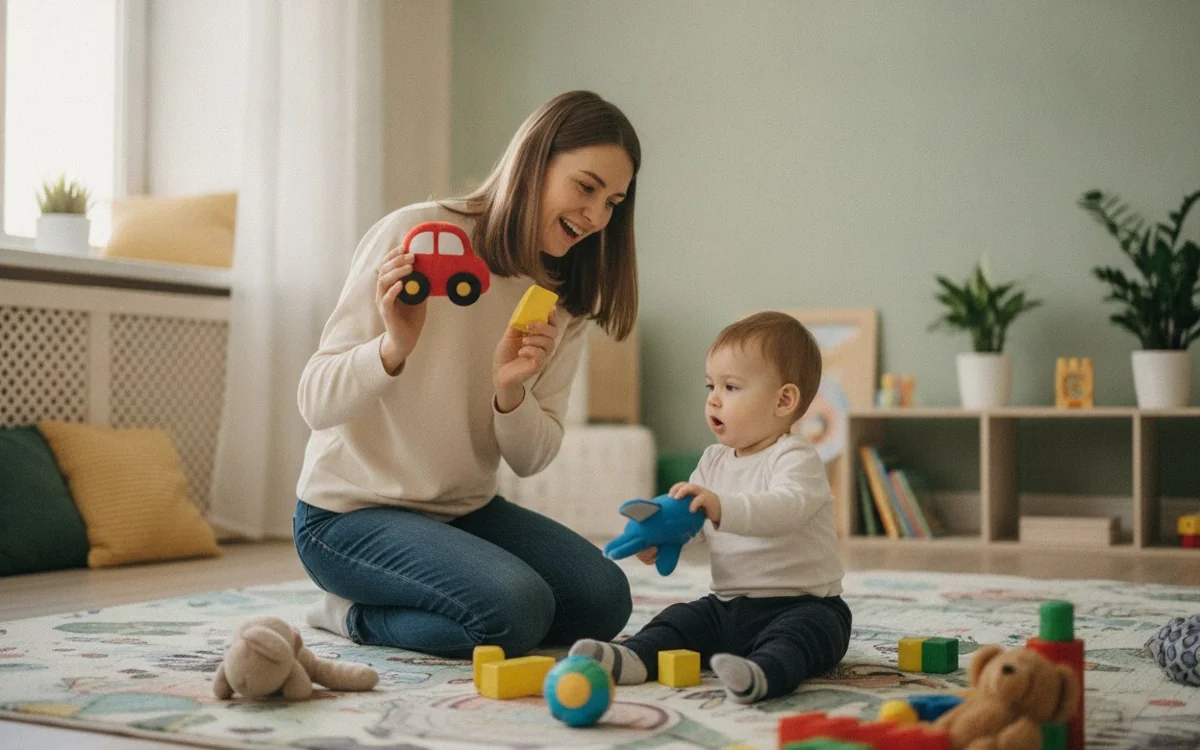
When a child hasn't started speaking by age two and by age three is silent or uses only a few sounds, parents feel anxious. This article will help you distinguish an individual developmental pace from a real speech delay, understand possible reasons for silence, and get concrete steps for home speech stimulation. We'll break down where to start to help a non-speaking child and when it's time to see specialists.
When a child is considered non-speaking: norms and warning signs
Many parents hear stories about children who started speaking after age three and reassure themselves, postponing a visit to a speech therapist. However, there are clear age-related benchmarks that help determine if there is cause for concern. Below is a table comparing typical speech development norms and signs indicating a possible delay.
Table of norms and warning signs
| Age | Speech norm | Warning sign |
|---|---|---|
| 6–9 months | Cooing, babbling (ba-ba, ma-ma) | Absence or monotony of sounds |
| 12 months | 3–5 simple words (mama, give, beep-beep) | The child does not understand spoken speech |
| 18 months | 10–15 words, simple gestures | Vocabulary less than 5 words |
| 2 years | Two-word phrases (mama, give) | Child doesn't say a single word at age two |
| 3 years | Complex sentences, questions | Child is silent at age three or uses 10–20 words |
If you notice at least one warning sign from the right column, do not wait—consult a specialist. Early correction yields significantly better results.
What is an "individual pace" and when it is not normal
Sometimes a child starts speaking later than peers, but their development is harmonious: they understand speech, follow requests, and actively gesture. In such cases, we talk about an individual pace. However, if by age two the child does not use even babbling words, and by age three does not form phrases, this is no longer a pace but a speech delay. A key marker is speech comprehension: a non-speaking child with intact intelligence understands spoken language, while with alalia or ASD, comprehension may be impaired.
When it's definitely time to see a speech therapist
Reasons for a visit to our specialist include the following situations: absence of babbling by one year, complete silence by two years, absence of phrasal speech by three years, as well as regression — when a child stops speaking words they previously used. Do not wait until the age of three — speech initiation is most effective when started between 1.5 and 3 years of age.
Why a child is not speaking: main causes
There are several reasons why a child does not start speaking, and it is important to understand yours in order to choose the correct correction strategy. Only a specialist can make a diagnosis after an in-person assessment, but for initial orientation, it is useful to know the main options.
List of possible causes of silence
Speech delay: The pace of speech acquisition lags behind the norm by 2–4 months, but speech comprehension and intellect are preserved. It often evens out with active stimulation.
Motor alalia: A speech formation disorder due to damage to the brain's speech areas. The child understands speech but cannot master vocabulary and grammar. Requires long-term work with a speech therapist-defectologist.
Sensory alalia: The child does not understand spoken speech, hears but does not distinguish sounds. Speech may be absent or consist of a meaningless set of sounds. Help from an audiologist and speech therapist is needed.
Hearing loss: Even mild hearing loss prevents a child from perceiving speech. A hearing test is the first step in diagnosing silence.
Autism Spectrum Disorders (ASD): The child avoids communication, does not make eye contact, and may not respond to their name. Speech is often absent or echolalic (repeating what is heard).
Pedagogical neglect: The child does not receive sufficient speech experience—little is spoken to them, books are not read, actions are not commented on. Speech may appear when a speech environment is created.
Where to start at home: first steps for speech initiation
Before rushing to specialists, you can start creating a proper speech environment at home. These simple but effective steps will help stimulate speech in a non-speaking child. It's important to do them regularly and with a positive attitude.
List of steps for home speech stimulation
Create a speech environment: Comment on everything you do: "I am washing the dishes, and this is a plate." Speak clearly, slowly, using simple phrases.
Use sound imitations: Start with simple sounds: "Cow—moo," "car—beep-beep." Turn this into a game without demanding immediate repetition.
Avoid "guessing": If a child points at a toy, don't hand it over silently. Say: "You want the ball? Say: ball" — and give it after their attempt to repeat, even if it comes out as "ba."
Limit screens: Until age 3, gadgets and TV should not replace live communication. Speech is learned only through dialogue, not from cartoons.
Play sensory games: Sort grains, draw with finger paints, mold with clay — this stimulates the brain areas responsible for speech.
Why it's important not to overload the child
Start with 5–10 minutes of active activities per day. If the child gets tired or turns away, take a break. Overload can cause refusal to communicate. Short but regular sessions are better than long but infrequent ones.
How to respond to first attempts
Any sound imitation or gesture is a victory. Celebrate and praise, but don't force repetition over and over. Your goal is to create a sense of success and a desire to communicate in your child.
Methods for initiating speech: from babbling to words
At our center, we use a comprehensive approach, combining different methods. The choice of a specific method depends on the cause of the silence and the child's age. Below is a table of the main methods used to stimulate speech.
Table of speech initiation methods
| Method | What it develops | Example |
|---|---|---|
| Speech rhythmics | Rhythm sense, articulation, auditory attention | Clapping to poems, stepping to the rhythm of music |
| Eliciting onomatopoeia | Vocal activity, first syllables | Game "Who Says What": "Dog — woof-woof" |
| Sensory games | Interhemispheric connections, tactile perception | Sorting beans, drawing in sand |
| Breathing games | Speech exhalation, voice strength | Blowing out a candle, blowing cotton wool off the palm |
| Working from babbling to words | Transition from syllables to meaningful words | "Ma" → "mama," "bi" → "bee-bee" |
How a speech initiation session works
The session is structured as a game. First, we warm up the articulatory apparatus: blow on feathers, make a "smile" and a "trunk". Then we move to sensory games — sorting through grains, finding figures in them, and naming them. After that, speech rhythmics: clapping, stomping, singing syllables. We finish by eliciting onomatopoeia, gradually making them more complex into simple words.
When to expect first results
First onomatopoeia with regular sessions may appear within 2–4 weeks. Meaningful words can take from 3 to 6 months. However, timelines depend on the diagnosis: with alalia, the process may take up to a year; with delayed speech development, it is faster. Accurate prognoses are given by a specialist after diagnostics.
Which specialists a non-speaking child needs
Comprehensive diagnosis is the foundation of successful correction. Often parents only see a speech therapist, but the cause of silence may lie elsewhere. Here is a list of specialists your child might need.
List of specialists for diagnostics and correction
Speech therapist-defectologist: The primary specialist for speech initiation, correcting sound pronunciation, and developing speech comprehension. Works with DSD, alalia, dysarthria.
Neurologist: Rules out or confirms organic brain damage, prescribes medication support (nootropics, vascular drugs) if necessary.
Audiologist: Checks hearing—a mandatory step for a non-speaking child. Even a mild hearing loss can be the cause of speech absence.
Psychologist (neuropsychologist): Assesses cognitive functions and emotional-volitional sphere, helps with ASD and pedagogical neglect.
Psychiatrist (if necessary): Required if autism spectrum disorder, intellectual disability, or other mental disorders affecting speech are suspected.
Why comprehensive diagnostics are important
Often a child is silent not for one reason, but due to a combination of factors: for example, mild hearing loss plus pedagogical neglect. Without a full examination, you risk wasting time on the wrong approach. At our center, we conduct an initial diagnosis, refer to related specialists if necessary, and only then create a therapy program.
How to choose a speech therapist for a non-speaking child
Look for a specialist with experience specifically with non-speaking children. A speech therapist should be able to work with non-verbal children, use alternative communication (gestures, cards), and be patient and friendly. During the consultation, pay attention to how the specialist interacts with the child — a good speech therapist doesn't pressure but engages through play.
What not to do and what determines the timing of speech emergence
Parents, wanting to help, sometimes make mistakes that delay speech onset. It is important to know what not to do and understand what actual timelines depend on.
List of common parental mistakes
Don't wait for them to "start talking on their own": Before age three is the golden time for correction. If a child isn't speaking at age two, act immediately.
Don't overload your child with sessions: 15–20 minutes a day in a playful form is enough. Longer—the child gets tired and loses interest.
Don't force speaking: Phrases like "say," "repeat," if the child is not ready, cause negativity and refusal to communicate.
Don't use gadgets as a babysitter: Speech doesn't develop from cartoons; it requires live dialogue.
Do not compare with other children: Each child develops at their own pace. Focus on their individual progress.
What speech onset timelines depend on
Timelines depend on the cause of silence: with delayed speech development (DSD), speech may appear after 3–6 months of sessions; with motor alalia, after 6–12 months; with sensory alalia or ASD, from a year or longer. Regularity of sessions is also important: the more often you practice (10–15 minutes daily at home plus 2–3 times a week with a speech therapist), the faster the progress. The age at which correction begins also matters: the earlier, the better.
When to change tactics
If after 3–4 months of regular sessions there is no progress—no sound imitations, no gestures, no speech comprehension—it's worth reconsidering the program and undergoing a repeat assessment. The cause may be deeper than assumed, or a different specialist may be needed. Remember that precise recommendations are given by a specialist after an in-person assessment—do not self-treat.
