Speech development of a 2-year-old child: norms and signs

· 7 min read
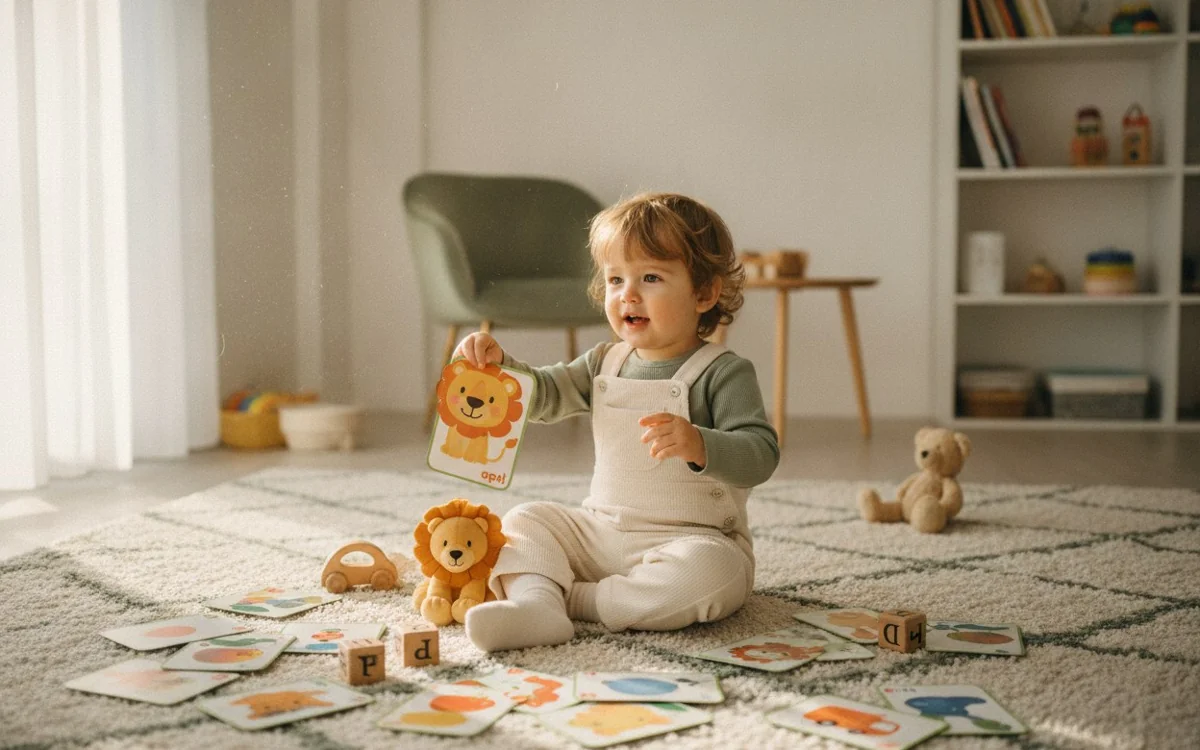
Age two is when parents often first start to worry: "Is my child starting to speak too late?" In this article, as a practicing speech-language pathologist, I will explain the objective speech norms at age 2, what signs to look out for, and what to do if you think your child is not speaking at age 2.
Speech norms at age 2: from babbling to first phrases
By age two, a child's speech undergoes a real leap: from individual sounds and simple syllables, they move to meaningful words and attempts to form simple sentences. It's important to understand that this is not an instant process, but a dynamic one that can be tracked through key milestones. Below is a table to help you navigate.
How many words should a child say at age 2
Term: Vocabulary at age 2 is not an exact number, but a range from 50 to 300 words. If the toddler says fewer than 20 words, this is a reason for a consultation.
Table: Speech development milestones (18–30 months)
| Age | Active vocabulary (how many words they say) | Passive vocabulary (what they understand) | Phrase speech |
|---|---|---|---|
| 18 months | 10–20 words | 100–150 words | Individual words, onomatopoeia |
| 24 months | 50–300 words | 300–400 words | Simple phrase of 2 words (Give ball) |
| 30 months | 300–500 words | 500+ words | Phrase of 3-4 words, questions (Where is mom?) |
Understanding of spoken speech and first phrases
The child does not just repeat words; they begin to understand their meaning in context. At age 2, they can follow a two-step request (Take the cup and put it on the table), know the names of body parts, clothing items, and actions. A phrase is the main indicator: speech development at age 2 implies the emergence of two-word constructions (Mom, give; Kitty beep-beep; Dad, go). If the child only uses individual words or gestures without combining them, this may indicate a delay.
Norms of sound pronunciation at this age
Normally, by age two, a child may pronounce sounds inaccurately or soften them (kasa instead of kasha, tyuba instead of shuba). This is age-related softening. Substitutions of complex sounds (R, L, Sh, Zh, Shch, Ch) with simpler ones are acceptable. A warning sign is if the toddler does not pronounce vowels (A, O, U, I) or the simplest consonants (P, B, M, T, D, N, K, G, Kh). Normally, by age two, the following sounds should appear in speech: A, O, U, I, Y, E, P, B, M, T, D, N, K, G, Kh, V, F, Y.
Alarming Signs of Speech Delay at Age 2
Parents often attribute silence to personality, laziness, or imitation of older siblings. However, there are clear markers that indicate a speech delay at age 2 and require a specialist's attention.
List: When to be concerned
- Absence of babbling and cooing: If the child did not coo or babble (e.g., agu, ba-ba, ma-ma) before age one.
- No meaningful words: By age 2, there is not a single meaningful word, even a simplified one (beep-beep, yum-yum).
- Does not understand simple requests: Does not respond to "give," "here," "show," cannot point to body parts upon request.
- Does not point: At 1.5–2 years, this is a key gesture—the child should point at an object to share interest or make a request.
- Speech regression: The child used to say 10–20 words but then stopped talking or stopped using them. This is the most alarming sign, requiring an urgent visit to a neurologist and speech therapist.
- Absence of two-word phrases: By age 2.5, the child does not try to combine words (Mom, give; Kitty, here).
- Uses only gestures: The child communicates mainly by screaming, crying, or gestures, without trying to replace them with words.
Why delays occur: from normal variation to pathology
The reasons why a 2-year-old child does not speak can vary — from a harmless individual developmental pace to serious disorders. It is important not to panic, but also not to reassure yourself without a diagnosis.
List: Main causes of delay
- Individual pace: The child develops at their own pace, often catching up to peers by age 3. This is usually the case for boys or children whose older siblings speak for them.
- Speech delay (SD): Delay in the formation of all speech components with preserved intelligence and hearing. Requires therapy sessions.
- Hearing loss: Even mild hearing loss (the child hears but poorly distinguishes speech sounds) leads to delays. Have their hearing checked by an ENT doctor.
- Lack of communication: The child spends a lot of time with gadgets or silent adults. Speech develops only in live dialogue.
- Bilingualism: If a family speaks two languages, the child may start speaking later (by 2.5–3 years), but their passive vocabulary is richer. It is important that each parent speaks one language.
How to develop a child's speech at home: practical techniques
Parents are the main helpers in speech development. Daily 15–20 minutes of focused play have a greater effect than rare sessions with a specialist without home support. The main rule: develop a child's speech through play and joy, without pressure.
Table: Home games for speech development
| Appointment | What it develops | How to do it (example) |
|---|---|---|
| Commentary | Passive vocabulary, comprehension | Say out loud everything you do: "I am washing the plate. The plate is clean. Now I will dry my hands." |
| Reading and nursery rhymes | Auditory attention, speech rhythm | Read with intonation, show pictures. Nursery rhymes (Magpie-Crow) stimulate articulation. |
| Fine motor skills | Speech centers in the brain | Games with cereals, mosaics, lacing, modeling with dough. |
| Onomatopoeia | Active speech | Play with toys: "How does the cow say? Moo. And the car? Beep beep." |
| Limiting gadgets | Live dialogue, initiative | Limit cartoons to no more than 15–20 minutes a day. Speech develops only in dialogue, not in background noise. |
Games for articulation development
Articulation gymnastics at age 2 is not boring exercises in front of a mirror, but a fun game. The simplest and most effective are sound imitations and imitating animals. Do “fence” (smile with closed teeth), “trunk” (pursing lips into a tube), “clock” (tongue left-right) together with your child. It is important to do everything with a smile, in front of a mirror, so the child can see your face. If the toddler refuses to repeat, do not insist — do it yourself, they will start imitating later.
Reading books and speech games
Choose books with large, realistic pictures and a simple plot (Suteev, Barto, Chukovsky). Read slowly, point to and name objects. Ask simple questions: “Where is the doggy?”, “Who is this?”. Play hide-and-seek with toys: “Where is the bear? Here he is!”. Use finger games (Pat-a-cake, This finger is grandpa). Remember: how to develop a child’s speech is about regularity, not duration. Five minutes a day, but every day.
Myths about speech at age 2 that hinder parents
Parents often fall into the trap of common misconceptions that prevent them from noticing a problem in time. Let's break down three of the most persistent myths.
Myth 1: "Boys start speaking later than girls"
This myth has only a partial basis. Indeed, boys' speech areas of the brain mature slightly slower, and on average, they start speaking 2–3 months later. However, the difference should not be drastic. If a child says no words at age 2, it's not a "boy thing" but a reason for a consultation. The norm for a boy at age 2 is the same 50 words and simple phrases. Waiting until age 3, "when he'll start talking," is a dangerous strategy.
Myth 2: "Don't worry, he will talk on his own"
This is the most harmful myth. In some cases (individual pace), the child does catch up to the norm by age 3. But if silence is caused by speech delay, dysarthria, alalia, or hearing loss, lost time means losing the sensitive period for speech development. The earlier correction begins, the faster and easier recovery will be. After age 3–4, working with speech becomes much more difficult. "He'll start talking on his own" is not a method, but a risk.
Myth 3: “Bilingualism delays speech development”
Research shows that bilingualism does not cause a delay, but only changes its trajectory. A child growing up in a bilingual environment may start speaking a bit later (by 2.5–3 years), but their vocabulary in both languages combined meets the norm. A problem arises if languages are mixed in one adult's speech or if parents do not pay attention to developing each language. If you live in Almaty and speak Kazakh and Russian at home, that's normal. You should be concerned if the child does not understand either language at a basic level.
When to show a child to a speech therapist and what diagnostics provides
Many parents think that you only go to a speech therapist at age 5 to "correct sounds." This is not true. At our center, we accept children from 1.5–2 years old. Early diagnosis is an opportunity to correct delays in time.
At what age does diagnosis make sense
The optimal age for a first consultation with a speech-language pathologist is 2 years. If there are clear alarming signs from the list above, you can come earlier, at 1.5 years. Diagnosis at this age is not like a school test—it's a game where the specialist assesses speech comprehension, vocabulary, articulatory apparatus condition, play skills, and communication. Don't wait until age 3 if you feel something is wrong.
What diagnostics at age 2 provides
PROSE: A diagnosis at age 2 helps answer the main question: whether the child's silence is a normal variant or a delay requiring correction. During the appointment, we assess not only the number of words but also the quality: whether there are onomatopoeias, how the child understands spoken speech, whether they use pointing gestures, and how they play. If a speech delay is identified at age 2, we provide a clear plan: what sessions are needed (individual or group), what games to play at home, and whether a consultation with a neurologist or audiologist is necessary. The exact timeline for correction depends on the diagnosis and regularity of sessions — each child has their own path. But the earlier you start, the shorter this path will be. Do not postpone a visit if something concerns you — it is better to be safe and ensure everything is fine than to miss the right time.
